MetaOrigami

MetaOrigami: Origami-Inspired Metamaterials, Parametric CAD and Digital Fabrication
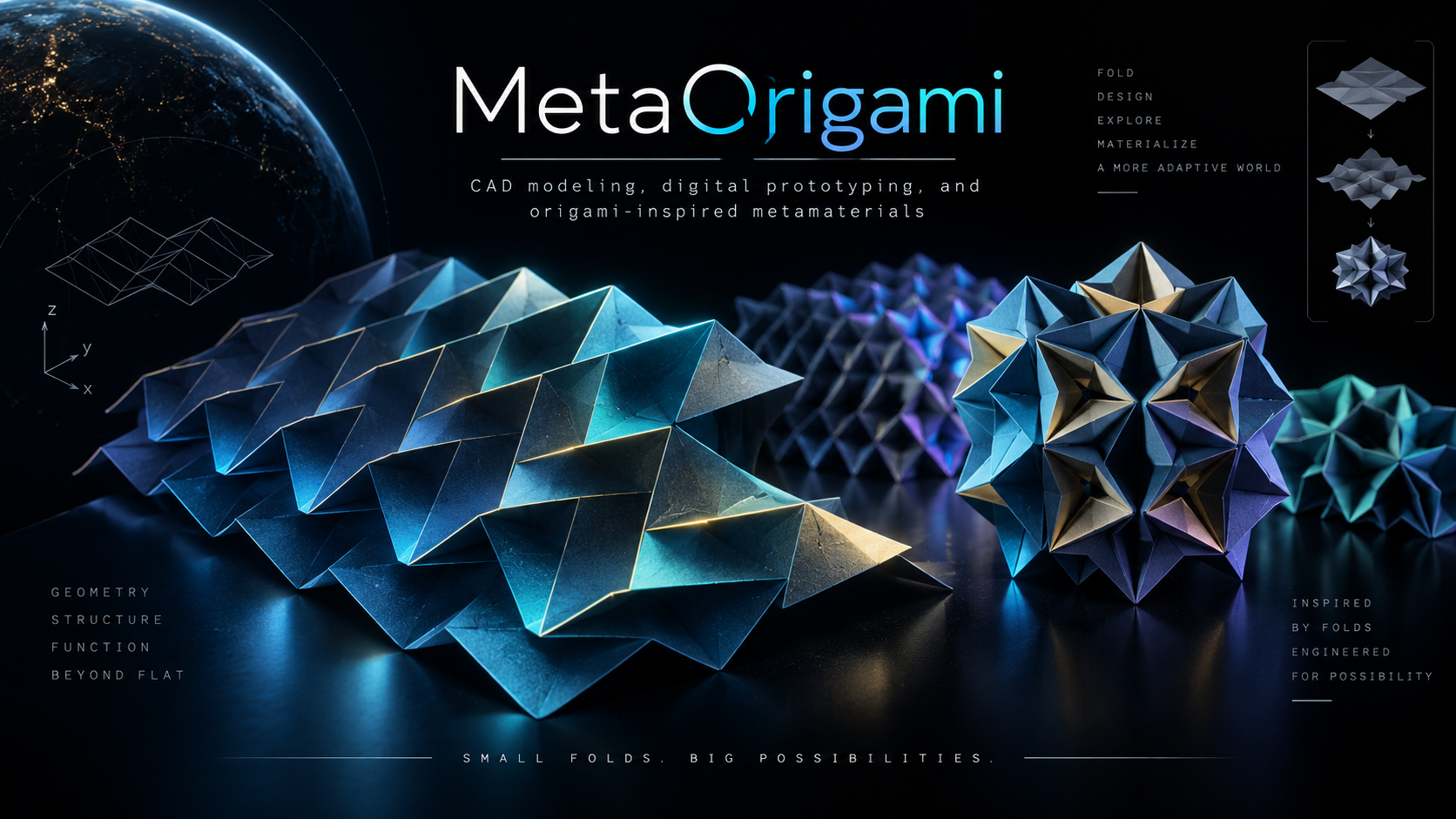
Table of Contents
- Overview
- Research Approach
- Miura-ori
- Miura-ori CAD Model
- Miura-ori Crease Pattern
- Kresling
- Miura Alphabet
- Available Files
- Digital Fabrication
- Repository Structure
- Authors
- Institutional support
- Funding
- License
- Citation
Overview
MetaOrigami is an undergraduate research project focused on the geometric design and digital prototyping of origami-inspired meta-structures.
The project investigates how a relatively simple local folding pattern can be repeated, parametrized and reorganized to produce larger structures with complex global geometries.
The work combines:
- origami geometry;
- parametric CAD modeling;
- crease-pattern design;
- tessellation;
- geometric analysis;
- digital fabrication;
- modular design;
- reconfigurable structures;
- origami-inspired metamaterials.
The main architecture investigated is the Miura-ori pattern.
The Kresling pattern is studied as a complementary cylindrical origami
geometry with a more strongly coupled parametrization.
Research Approach
The basic workflow adopted in the project is:
Origami pattern
      ↓
Geometric unit cell
      ↓
Parametric description
      ↓
Crease pattern
      ↓
CAD model
      ↓
Tessellated structure
      ↓
Digital prototype
      ↓
Complex global geometry
The central idea is that the geometry of the local cell controls the geometry and possible transformations of the larger structure.
This relationship between local rules and global form is one of the main motivations for studying origami architectures as mechanical meta-structures.
Miura-ori
Geometry
The Miura-ori is a periodic origami pattern constructed from a tessellation of parallelogram-like facets connected through alternating mountain and valley creases.
A single Miura cell can be described using geometric quantities such as:
- facet dimensions;
- acute angle of the parallelogram;
- fold angle;
- orientation of adjacent facets.
When cells are repeated, the complete sheet forms a coordinated mechanism in which many facets move simultaneously.
The pattern is particularly interesting because changes at the unit-cell level produce organized transformations of the entire tessellation.
Geometric Study
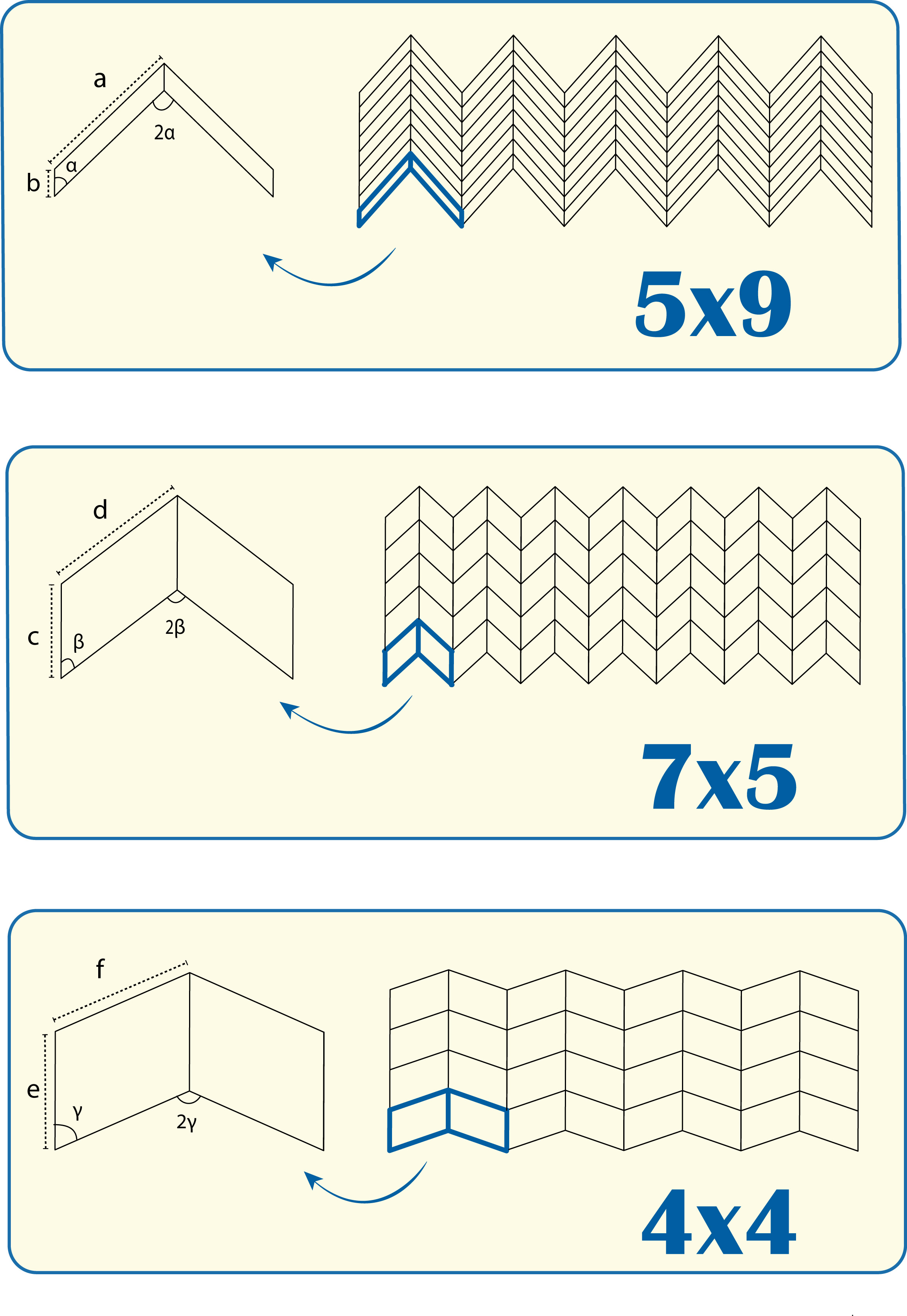
The project investigated different Miura-ori configurations by modifying the folding geometry and observing the resulting spatial arrangement.
The geometric study was used to analyze:
- different opening configurations;
- relationships between neighboring facets;
- compact and expanded states;
- geometric interference between panels;
- inversion of the expected configuration at large folding angles;
- organization of repeated cells.
The source material for this study is available in PDF, JPG and Adobe Illustrator formats.
| File | Format |
|---|---|
| Miuri-Ori_plan_angulos diferentes.pdf | |
| Miuri-Ori_plan_angulos diferentes.jpg | JPG |
| Miuri-Ori_plan_angulos_diferentes.ai | Adobe Illustrator |
Miura-ori CAD Model
A 7 × 4 Miura-ori tessellation was developed in Autodesk Fusion 360.
The CAD model provides a computational representation of the folded geometry and allows the structure to be inspected and reused in different digital workflows.
The model is available in three formats.
| File | Format | Description |
|---|---|---|
| MiuriOri_7x4.f3d | F3D | Autodesk Fusion 360 CAD model |
| MiuriOri_7x4_3D_v6.stl | STL | Triangulated 3D geometry |
| MiuriOri_7x4.obj | OBJ | General-purpose 3D geometry |
Download
Fusion 360
STL
Download MiuriOri_7x4_3D_v6.stl
OBJ
Miura-ori Crease Pattern
The planar crease pattern associated with the Miura-ori 7 × 4 model is available as both a vector CAD file and a PDF document.
The crease pattern represents the planar geometric information from which the folded architecture is constructed.
| File | Format | Description |
|---|---|---|
| MiuraOri_7x4.dxf | DXF | Vector crease geometry |
| MiuraOri_7x4.pdf | Crease-pattern document |
Download
Download the DXF crease pattern
Download the PDF crease pattern
Kresling
The Kresling pattern is a cylindrical origami architecture composed primarily of triangular facets arranged around a polygonal cross section.
Its deformation combines two characteristic motions:
axial displacement and rotation.
As the structure contracts or expands, neighboring rings rotate relative to one another.
This coupling makes Kresling geometries particularly interesting for the study of:
- deployable cylinders;
- compact structures;
- torsional mechanisms;
- bistable and multistable architectures;
- geometrically programmable structures.
Kresling Geometric Challenge
Kresling was investigated as a second origami architecture during the project.
Its CAD parametrization proved more demanding than the corresponding Miura-ori model.
For a closed cylindrical structure, parameters such as:
- number of polygon sides;
- polygon radius;
- cylinder height;
- diagonal dimensions;
- triangular facet angles;
- relative rotation between rings;
cannot generally be modified independently.
Changing one parameter affects other quantities required to preserve geometric closure.
The current work therefore represents an exploratory investigation of the Kresling geometry and its crease patterns.
Kresling Files
The current repository contains the following Kresling working files:
Kresling_6gon_A_and_B_TwoInchEdgeLength.dxf
KreslingArrayCreasePattern.dxf
KreslingArrayCreasePattern1.dxf
KreslingArrayCreasePattern1.studio3
These files document the geometric exploration carried out during this stage of the research.
Miura Alphabet
One of the main geometric experiments developed from the Miura-ori study was the construction of a complete alphabet using Miura-inspired modular geometries.
Instead of repeating the same tessellation indefinitely, local modules were reorganized to generate different recognizable global shapes.
The alphabet provides a visual demonstration of the principle:
local geometric unit
        ↓
controlled organization
        ↓
complex global geometry
The experiment demonstrates how a common geometric vocabulary can be used to construct many distinct macroscopic configurations.
This idea is relevant beyond typography. It provides a simple visual example of geometric programmability, in which the organization of local structural units determines the form of a larger meta-structure.
The CAD source developed during the project is:
Miura-Ori-Alphabet.f3d
Available Files
Miura-ori geometric study
| Filename | Type |
|---|---|
Miuri-Ori_plan_angulos diferentes.pdf |
|
Miuri-Ori_plan_angulos diferentes.jpg |
JPG |
Miuri-Ori_plan_angulos_diferentes.ai |
Adobe Illustrator |
Miura-ori 3D model
| Filename | Type |
|---|---|
MiuriOri_7x4.f3d |
Autodesk Fusion 360 |
MiuriOri_7x4_3D_v6.stl |
STL |
MiuriOri_7x4.obj |
OBJ |
Miura-ori crease pattern
| Filename | Type |
|---|---|
MiuraOri_7x4.dxf |
DXF |
MiuraOri_7x4.pdf |
Kresling
| Filename | Type |
|---|---|
Kresling_6gon_A_and_B_TwoInchEdgeLength.dxf |
DXF |
KreslingArrayCreasePattern.dxf |
DXF |
KreslingArrayCreasePattern1.dxf |
DXF |
KreslingArrayCreasePattern1.studio3 |
Studio 3 |
Miura Alphabet
| Filename | Type |
|---|---|
Miura-Ori-Alphabet.f3d |
Autodesk Fusion 360 |
Digital Fabrication
The geometric and CAD studies were complemented by physical prototyping.
Miura-ori structures were fabricated using different manufacturing approaches, including:
- laser cutting and scoring of high-grammage paper;
- laser processing of polypropylene sheets;
- FDM 3D printing of Miura cells;
- FDM 3D printing of larger Miura structures.
These prototypes were used to investigate the transition from ideal geometric models to physical objects.
Relevant considerations include:
- finite material thickness;
- fold realization;
- assembly;
- geometric continuity;
- manufacturing tolerances;
- repeatability of the unit cells.
The fabricated specimens are interpreted primarily as geometric and fabricability prototypes.
Origami-Inspired Metamaterials
Origami provides a useful design language for mechanical metamaterials because the global behavior of a structure can be strongly influenced by the geometry and connectivity of its repeating units.
In this context, the MetaOrigami project investigates a design hierarchy of the form:
          LOCAL SCALE

        Origami cell
             │
             ▼
     geometric parameters
             │
             ▼
       repeated modules

             │
             ▼

         GLOBAL SCALE

       meta-structure
             │
             ▼
      prescribed geometry
             │
             ▼
      reconfiguration
The Miura-ori and Kresling studies provide two complementary examples.
Miura-ori
A predominantly planar periodic architecture characterized by strongly coupled folding of repeated parallelogram-like facets.
Kresling
A cylindrical triangulated architecture characterized by coupled axial and torsional deformation.
Together they illustrate how different crease geometries can generate very different classes of reconfigurable structures.
Repository Structure
MetaOrigami/
│
├── README.md
│
├── Miura-Ori-Alphabet.f3d
│
├── Kresling_6gon_A_and_B_TwoInchEdgeLength.dxf
├── KreslingArrayCreasePattern.dxf
├── KreslingArrayCreasePattern1.dxf
├── KreslingArrayCreasePattern1.studio3
│
├── EstudoCelulas/
│   │
│   ├── Miuri-Ori_plan_angulos diferentes.pdf
│   ├── Miuri-Ori_plan_angulos diferentes.jpg
│   └── Miuri-Ori_plan_angulos_diferentes.ai
│
└── FusionGeometries/
    │
    ├── Modelo_3D/
    │   │
    │   ├── GuiaArquivos3D.gdoc
    │   │
    │   └── MiuriOri/
    │       ├── MiuriOri_7x4.f3d
    │       ├── MiuriOri_7x4_3D_v6.stl
    │       └── MiuriOri_7x4.obj
    │
    └── Modelo_dxf_dwg/
        │
        └── CreasePattern/
            └── MiuraOri/
                ├── MiuraOri_7x4.dxf
                └── MiuraOri_7x4.pdf
Authors
- Ana Beatriz Alencar Dias (UFRJ)
- Americo Cunha Jr (LNCC & UERJ)
Institutional support



Funding



License
MetaOrigami is released under the MIT license. See the LICENSE file for details.
Contributions are welcome and are distributed under the same license.

Citation
If you use material from this repository in academic work, please cite the project as:
A. B. A. Dias and A. Cunha Jr,
MetaOrigami: Origami-Inspired Meta-Structures, Parametric CAD and Digital Fabrication, GitHub repository, 2026.
BibTeX:
@misc{DiasCunha2026MetaOrigami,
    author       = {A. B. A. Dias and A. Cunha Jr},
    title        = {MetaOrigami: Origami-Inspired Meta-Structures, Parametric CAD and Digital Fabrication},
    year         = {2026},
    howpublished = {GitHub repository}
}